

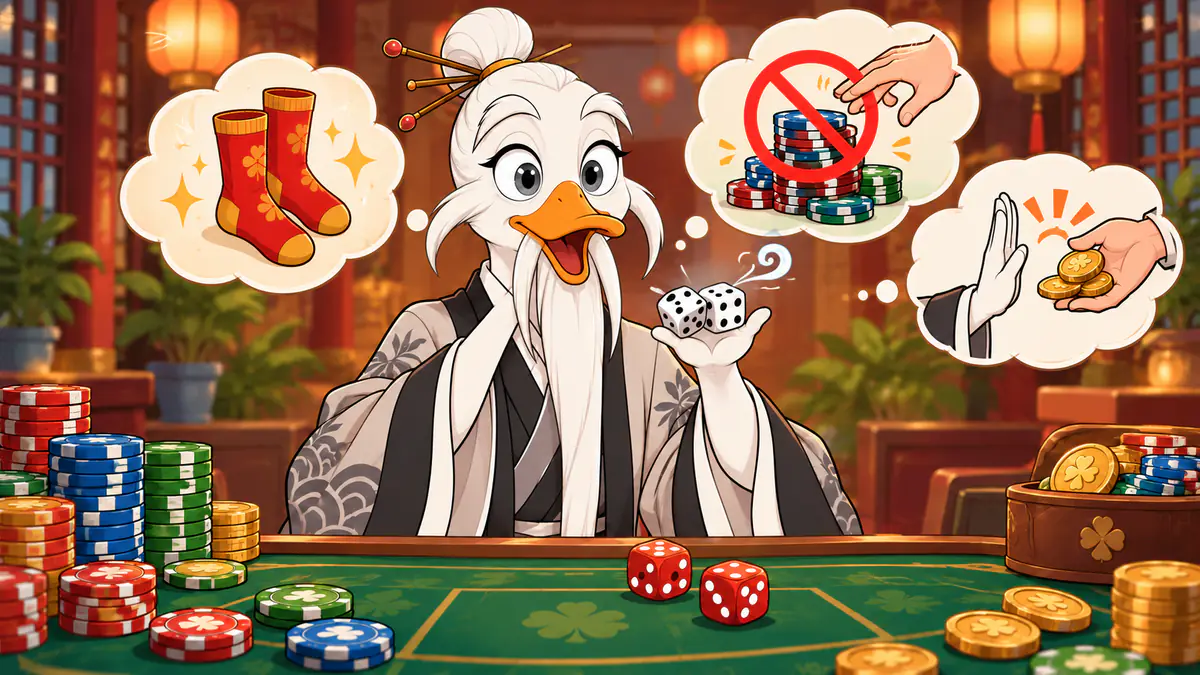
- Rituals give players a sense of control over events that are really random.
- Psychologists call this the illusion of control — and it can lead to bigger bets.
- Most rituals are harmless fun; the risk comes when they change how much you bet.
Every casino floor is full of tiny ceremonies. A woman taps the slot screen twice before each spin. A craps shooter whispers to the dice. A blackjack player won't let anyone sit at third base. The Sensei, who always bows once to a new table ("manners cost nothing"), has catalogued the most common rituals — and what's really going on.
The classic rituals
Blowing on the dice. The most famous gambling habit. The idea is to "warm up" the dice or breathe your luck into them. Some historians suggest it started as a way to check dice weren't rigged. Many casinos now discourage it — for hygiene, not superstition.
Lucky clothes. Socks, shirts, hats, underwear (we don't ask). Many regulars have an outfit they won in once and have worn ever since.
Never counting money at the table. Counting your chips mid-session is said to scare away luck. The polite moment to count is when you've left the table.
Don't lend money at the table. Lending is said to transfer your luck to the borrower.
Avoid crossed legs. Some players believe crossing your legs "crosses" your luck.
Tapping and rubbing. Tapping a slot screen, rubbing a statue's nose on the way in, touching the felt before a hand.
Seat and dealer superstitions. Refusing a certain seat, changing tables after a loss, avoiding a dealer who "never pays".
Rituals around the world
- China and Macau: players avoid the number 4, prefer 8 and wear red; some won't enter a casino through the main door in case it's "bad luck".
- Italy: touching iron or making the corna hand gesture wards off bad luck — and nobody wants Friday the 17th.
- United States: rabbit's feet, lucky coins and the obsession with 7 at the craps table.
- UK: horse-racing punters keep lucky pens and always bet "each way" on a name that "means something".
Why we do it: the illusion of control
In the 1970s, psychologist Ellen Langer ran a series of famous experiments on what she called the illusion of control. People valued lottery tickets they'd chosen themselves more than ones handed to them, and behaved as though skill mattered in games of pure chance. Other researchers noticed that craps players throw the dice harder when they want high numbers and gently for low ones.
Rituals fill the gap between wanting control and having none. They're comforting, social and often fun. In games involving skill — poker, sports — a calming routine may even help performance, the way athletes have pre-game rituals.
When rituals become a problem
Most habits are harmless. Watch out when a ritual starts to change your money decisions:
- "My lucky shirt is on, so I'll bet bigger tonight."
- "I'm sitting at my lucky table, I can't leave while I'm losing."
- "I always play until my lucky number comes up."
That's where the illusion of control meets the gambler's fallacy — and budgets get broken.
If you'd like a ritual that's free, harmless and genuinely fun, ask the Sensei for your daily reading on the lucky day calculator. And if gambling ever stops feeling like fun, our responsible gambling page lists help.
FAQ: gambling superstitions
Why do people blow on dice?
Traditionally to 'warm up' the dice or transfer the player's luck to them. Some say it began as a way to check dice weren't loaded. It doesn't affect the roll — and many casinos now discourage it for hygiene reasons.
Why is it bad luck to count money at the table?
An old gamblers' superstition says counting your chips or cash at the table 'scares away' your luck. In practice it's simply considered bad etiquette while play is going on.
Do rituals help you win?
No. In games of pure chance, rituals have no effect on outcomes. They can make you feel more confident, which isn't a problem unless it leads you to bet more.
What is the illusion of control?
A well-documented tendency to believe we can influence outcomes that are actually determined by chance — for example, throwing dice harder for high numbers.