
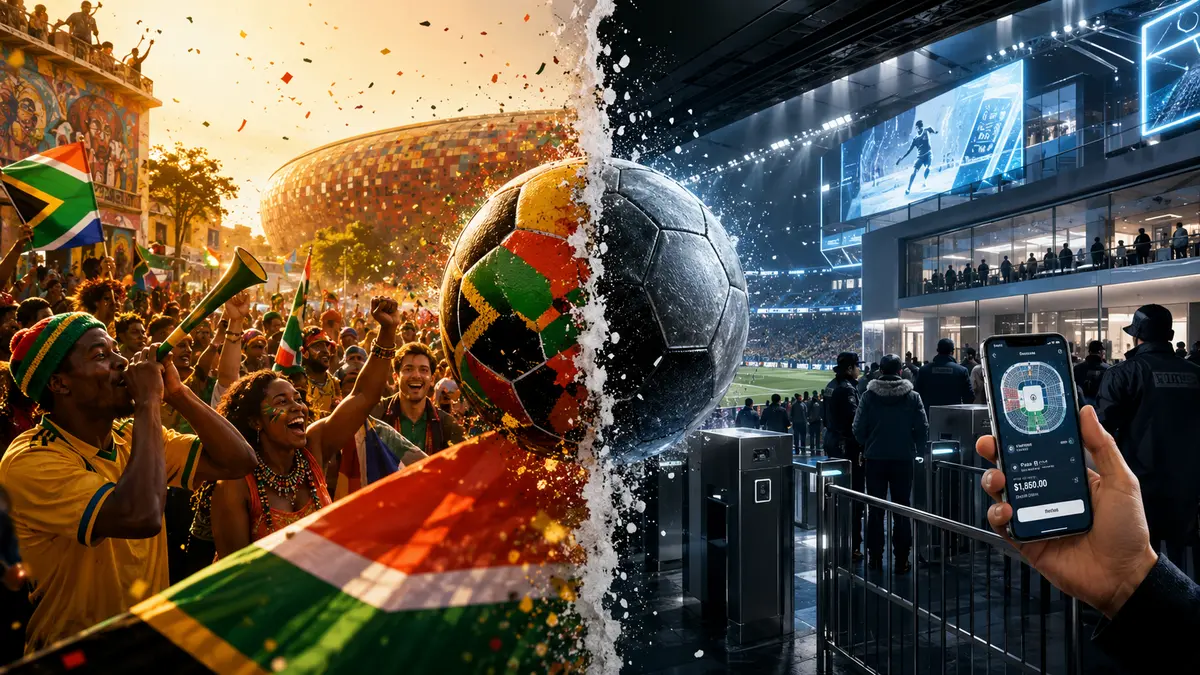

There is a particular kind of grief that only sports fans understand: the grief of watching something you love slowly become something you no longer recognize.
It arrived for me — and apparently for thousands of others — in the form of a Reddit post. User Lucky_Mongoose_4834 dropped a deceptively simple observation into r/worldcup roughly two months before the 2026 FIFA World Cup kicked off on June 11:
“I was in South Africa for the 2010 World Cup. I’m in the USA for the 2026 World Cup. I can’t believe the difference… 2010 was all folks talked about for years. The whole country was united in purpose, tickets were hard to get, and fans were welcomed like friends. It was probably one of the seminal moments of that nation, a thing people will talk about with their grand kids. I think if I walked down the street today, I’d be hard pressed to find a single person in my US city who knows that the World Cup start in 30 days, let alone who’s playing, where or when.”
I was in South Africa for the 2010 World Cup. I’m in the USA for the 2026 World Cup. I can’t believe the difference…
by
u/Lucky_Mongoose_4834 in
worldcup
That post, still accumulating responses, eventually drew over 2,000 comments. It became, quite unintentionally, one of the most honest public conversations about what the World Cup has become, who it belongs to, and whether it can still be the universal festival of football it once was. The thread is worth dissecting — not just because it is a fascinating sociological snapshot, but because it raises questions that neither FIFA nor the American sports media seem particularly interested in answering.
I. Waka Waka vs. Jelly Roll
Let’s start with what the original poster is really mourning, because it is not, primarily, an American problem.
South Africa 2010 was genuinely extraordinary. Not just in the sentimental way that every world cup is “extraordinary” to those who attended it — but structurally, historically, emotionally. The 2010 tournament was only the second World Cup ever held in Africa, in a country that had been isolated from international sport for decades under apartheid, then reintegrated into the global community in the mid-1990s. The emotional stakes were enormous. As research published in the academic journal Frontiers in Psychology noted, the 2010 World Cup generated what scholars have since called “ecstatic nationalism” — a genuinely coordinated collective emotion, not manufactured, not marketed, but real. COSATU, South Africa’s major trade union federation, described it as an “unprecedented feeling of national pride and self-esteem.”
This was not just football. It was a post-apartheid nation telling itself — and the world — that it had arrived.
User Bacch put it beautifully, in what is arguably the best comment in the entire thread:
“I went to the World Cup in SA in 2010… Hotel staff wearing their Bafana Bafana jerseys under their uniforms (not just in the big cities, either — up in Kruger Park where I went between matches). Every screen in the country had the games on. Went to wine country down by Cape Town between matches and every single tasting room had a screen showing the matches… The kitchen staff loaned us a radio to listen to the evening’s games on, and when we got out of range of the English stations, the bartender stood with us and gave us rough play by play translation… Signs outside of stores that said ‘Please do not blow your vuvuzela inside the store, you will be asked to leave.’ People shouting ‘Ayoba!’ in the streets at night.”
Even user unsolicitedPeanutG, a South African who self-identifies as someone who doesn’t even like football, felt it:
“It was amazing. Our entire school structures changed to accommodate the World Cup and everyone was into it. We practised soccer dances for PE and learnt about the different countries for geography. In history we learn the significance of this event happening so soon after apartheid. In math, our calculations involved soccer balls and vuvuzelas. I had such a fun time and I’ll never forget it.”
Now consider the 2026 World Cup anthem. Shakira’s “Waka Waka (This Time for Africa)” from 2010 has over a billion YouTube views and is still instantly recognizable to hundreds of millions of people who couldn’t name a single player from that tournament. The 2026 anthem is a collaboration between Carin Leon and Jelly Roll. As user Traditional-Foot5374 dryly observed: “Unfortunately it’s Carin Leon featuring Jelly Roll 💀” — and user Brexinga confirmed it sits at roughly 5.8 million views on FIFA’s YouTube page months after release. A revealing number.
You could argue the song is a symptom, not a cause. But symbols matter in football. They are the tissue that connects individual matches to something larger. And the 2026 World Cup’s cultural footprint, measured by almost any metric — anthems, merchandise visibility, street-level awareness, editorial coverage — has been, to put it charitably, muted.
II. The Structural Problem: Three Countries, Zero Host
Part of the problem — perhaps the most honest part — is genuinely structural, and not entirely FIFA’s fault.
South Africa, 2010: one country, nine cities, 31 million people, almost 1.2 million square kilometres.
USA/Canada/Mexico, 2026: three countries, sixteen cities, over 550 million people, approximately 23 million square kilometres — roughly nineteen times the land mass.
As user Various_Educator_756 noted with some insight: “SA 2010 was a massive, once-in-a-generation national project. Football is their religion, and the whole tournament was central to their post-apartheid national identity. The entire country felt unified because it was the center of their universe. The US is just a completely different beast… A match happening in Miami barely registers for someone living in Seattle.”
User joshcbus offered a simple but clarifying data point: “There are 60-66 metro areas in the US with more than 1 million people. 11 of those are hosting World Cup matches. The closest match to my city is either a 6 hour drive to Canada or a 12 hour drive to NYC. I would basically need to fly to get there.”
This is the real consequence of the tri-nation format that, on paper, seemed like a brilliant expansion of football’s footprint in North America. In practice, it has produced a tournament with no true center of gravity. No city woke up and thought, “the World Cup is here.” Sixteen cities got a handful of games each, while the rest of the continent got nothing at all. The tournament is everywhere and nowhere simultaneously.
User drodrige captured this: “Having it in three countries definitely isn’t helping, it’s just too spread out across an enormous territory. Having 16 cities so distant from each other is too much.”
Even the famously passionate Mexican football culture — which should have been carrying enormous energy into this tournament — seems somewhat diluted. User mmonzeob from Mexico City wrote: “I live in Mexico City and couldn’t get tickets. I was willing to pay a considerable amount but I wasn’t lucky with the draws.” Her father attended the 1970 and 1986 World Cups in Mexico. She cannot attend the one in her own city.
III. The Price That Killed the Party
If the structural problem explains the absence of national unity, the ticket pricing explains the absence of ordinary fans — and this is where FIFA’s culpability becomes hardest to defend.
Let’s put the numbers on the table plainly:
In 1994, the last time the US hosted, tickets for first-round games ranged from $25 to $75 (the opener was $40-$120). The World Cup final at the Rose Bowl cost between $180 and $475. Total tournament profit: approximately $40 million. Average attendance: 68,991 per game — a record that, remarkably, still stands in 2026.
Adjusting for inflation alone, those 1994 prices would translate to roughly $55–$165 for group stage matches and up to around $1,050 for the final. That would already be steep. Instead, FIFA priced individual group-stage games between $140 and $2,735 at face value. The final at MetLife Stadium went on sale at $4,185–$8,680, later raised to a maximum of $10,990 through “dynamic pricing.” On the secondary market, according to reporting by ESPN, tickets have been listed for more than $2 million. On resale platforms, following the 30-times-oversubscription of official ticket demand, even average seats for popular games were reaching $1,500–$2,500.
The human cost of these numbers is visible throughout the Reddit thread. User ItsbeenBroughton wrote: “My parents paid $23 a ticket in 94. I’ve been looking forward to this for years. Tickets to see my own country play are $2,500 each. FIFA’s greed has forced me to choose sending my family into years worth of debt or watching on TV. Sharing a moment with my kids was stolen from us.”
User srcuello made a promise to themselves in 1994: “As a soccer-loving child in 1994, I promised myself I’d do whatever it takes to get tickets if the US ever hosted again. In 2026, I couldn’t be less excited to host. It’s highway robbery.”
User spacecat17 captured the bitter irony: “My friends and I all talked about how we can’t wait to be able to afford and travel to go to a WC in the US when it comes back. Now it’s here and we can’t afford to go to a WC in the US.”
And user Robby777777 passed along his son’s experience: “The CHEAPEST he could find was $7,000 a ticket. $14,000 for him and his wife to go to a match is beyond ridiculous.”
This is the paradox that FIFA seems content to ignore: they have generated extraordinary numbers on paper — nearly 2 million tickets were sold during the first two sales periods alone, with requests outnumbering available supply by more than 30 times — while simultaneously producing a tournament that millions of genuine football fans feel entirely locked out of.
The economic logic was explained with admirable candor by a market economist quoted in ESPN’s reporting: “An authorized resale market enables the seller to control the exchange and charge commissions and is the seller’s best revenue-maximizing mechanism. That is the core economic logic behind FIFA’s resale platform.”
Revenue-maximizing. Not fan-maximizing. Not football-maximizing. The language is telling.
The average price for a Category 1 ticket across the 2026 tournament is now about $563 — more than twice the $253 average from Qatar 2022. And Qatar 2022 was itself widely criticized for being unaffordable. We are iterating upward, tournament by tournament, pricing the game further and further out of the reach of the people whose love built it.
LA Mayor Karen Bass reportedly described the 2026 World Cup as “the games for the elite of the world.” She was not wrong. She was just stating it as a fact rather than as a scandal.
IV. The Infantino-Trump Problem
Any honest account of the atmosphere surrounding the 2026 World Cup has to address the political dimension — not because politics should infect football, but because in this case it already has.
In December 2025, at the tournament draw ceremony at the Kennedy Centre in Washington DC, FIFA President Gianni Infantino presented Donald Trump with the inaugural “FIFA Peace Prize — Football Unites the World.” The complaint stems from Infantino awarding Trump FIFA’s inaugural peace prize during the December 6 draw for the 2026 World Cup. Rights group FairSquare accused FIFA of breaching its own duty of neutrality.
The Norwegian Football Association’s president, Lise Klaveness, called for the prize to be scrapped. Australian international Jackson Irvine said it made “a mockery” of FIFA’s Human Rights Policy. Irvine said decisions like the awarding of the peace prize feel like they “set us back in the perceived market of what football currently is, especially at the top level, where it’s becoming so disconnected from society and the grassroots of what the game actually is and means in our communities and in the world.”
Among the American football fans in the Reddit thread, the effect was palpable and corrosive. User dmac3232: “Between the prices and Infantino chortling Trump’s balls, there’s absolutely no fucking way I’m spending a cent on this event.”
User schmeaganator17 articulated the dilemma clearly: “One of the things that dampens my excitement is the political atmosphere. Sandbagging the World Cup is viewed as a method of protest to make Trump look bad. In another life, I would’ve been shelling out thousands to see games in my home country. I want to minimize my financial support for the World Cup, but I will be watching every second.”
User captain_falc25 offered a nuanced reading: “Americans are living through some truly unprecedented times right now. Since the 2024 election, every day has been dominated by just awful stories that the majority of the country does not support… It’s also true that the people who are big into soccer in this country are more likely to be opposed to this administration, and therefore spending more time and energy protesting.”
I want to be careful here. The World Cup should not be political. It never has been — at least not by design. And there are legitimate counterarguments: the 2010 World Cup was held in South Africa, still navigating enormous socioeconomic inequality and poverty. The 2018 World Cup was in Putin’s Russia. The 2022 World Cup was in Qatar, where migrant workers died building the stadiums. Every World Cup, if you look closely enough, has blood or compromise somewhere in its foundation.
But there is something specifically toxic about Infantino’s relationship with Trump: it has contaminated the thing that was supposed to be above all of it. The FIFA Peace Prize wasn’t merely a diplomatic gesture. It was a signal that the most powerful man in world football had decided to publicly align himself with a deeply divisive political figure, in the most visible possible way, six months before his tournament began. Whatever football fans thought of Trump, they now had to watch FIFA grovel before him every time the tournament was mentioned. The beautiful game became a prop in a political spectacle.
V. The American Exception: Fair Excuse or Lazy Deflection?
The thread produced a chorus of people explaining — reasonably — that comparing American World Cup enthusiasm to South African enthusiasm is inherently unfair. The arguments are genuine:
The US has the NFL, NBA, NHL, MLB, college football, and college basketball, all with their own deep tribal loyalties, all competing for the same finite pool of American attention. In June 2026, when the World Cup started, the NBA Finals and Stanley Cup were still being contested. User Sad_Virus_7650 pointed out accurately: “The NBA and NHL playoffs are going on now, plus baseball just started, so people are much more focused on those.”
The US is geographically vast. As user StandEnvironmental44 put it: “The US is best understood as 30-ish distinct countries rather than one big one in a sports context. We have about 124 major professional sports teams, and the fandom and rivalry between those teams is at the forefront of the country’s focus 99% of the time.”
And soccer, while growing, remains outside the major-sport mainstream for a large percentage of the country. User Doublestack2411: “Soccer is the #1 sport for most places over the world, but not the US. We have Baseball, Basketball, Hockey, and American Football. You can’t expect the entire country to act as excited just because it’s a more popular sport in Europe.”
All of these are true. But they feel, at a certain point, like they are arguing against something nobody actually claimed. Lucky_Mongoose_4834 wasn’t expecting the United States to be South Africa. They were noting that the World Cup barely registered as a cultural event — that it felt, in the words of user RecentSpecial181, not like a party but like something happening in the background.
And this matters because the US is not supposed to be a bystander. It’s supposed to be a host. Hosting the World Cup means something. It means you are the face of football for six weeks. The entire organizing philosophy of the tri-nation bid was that North America’s energy and infrastructure would make this the biggest, most exciting, most commercially successful World Cup in history.
Whether that claim stands depends a lot on what you think “successful” means.
VI. What Actually Happened When the Games Started
Here is where the narrative becomes complicated and, frankly, more interesting than the pre-tournament gloom suggested.
After one week, the 2026 World Cup delivered goals, drama, historic performances, packed stadiums and nonstop energy. The stars shone, the fans showed up, and the biggest sporting event on the planet appeared to be living up to the hype.
More than one million fans attended the opening 16 games at the World Cup, with stadiums 99.34 percent full, according to FIFA data.
A new single-day attendance record was set: a combined crowd of 281,223 fans packed stadiums, the highest attendance ever recorded for four World Cup matches on the same day. Lionel Messi produced the first World Cup hat trick of his legendary career. Erling Haaland finally made his long-awaited World Cup debut, scoring twice as Norway rolled past Iraq 4-1.
Back in the thread, the early comments from people already at games were notably different in tone. User Due-Use-3707: “Get off the internet and go actually walk around. I was at the games this week in Seattle and the energy was insane and everyone was having a blast experiencing everyone’s different cultures, accents, foods, etc.”
User Patticus1291: “Seattle Really Showed up and showed the country what this cup is about! Some positive unifying patriotism as well! Everyone was united, singing, chanting, no division! Just peace love and footy!”
The original poster themselves updated their view: “We’re a week in, and it seems like finally it’s getting some traction. I’ve finally seen posts about it on social media.”
This is the pattern that user Diligent-Camel3773 predicted with remarkable accuracy, drawing on the 1994 experience: “I get you, but 1994 felt almost identical 30 days out. Most coverage was ‘will Americans even show up?’ Most people on the street couldn’t name a player on the squad. Then the games started, the Rose Bowl final pulled 94,000, and average attendance across the tournament was 68,991 per match — still the all-time World Cup record, three decades later. The US doesn’t build into a World Cup on approach, it builds on contact. You’ll probably feel the shift the week the first match kicks off.”
They were right. And this tells us something important: the pre-tournament apathy was real, but it is not the whole story. The games themselves have delivered what games almost always deliver — the irreducible spectacle of football, which tends to cut through cynicism once the whistle blows.
FIFA stated that the tournament was “firmly on course” to surpass the previous attendance record established at USA 1994. Given that the 1994 World Cup set records with a total attendance of 3,587,538 and an average of 68,991 per game — figures unsurpassed as of 2026 despite the expansion from 24 to 32 teams from 1998 onward — this would be a genuine achievement, at least numerically.
There have been, however, uncomfortable moments. Swathes of empty seats appeared at the match between South Korea and Czechia in Guadalajara and at the match between Qatar and Switzerland in Santa Clara, California. FIFA disputed the visual evidence, citing ticket scan data rather than seat occupancy. The distinction — between how many people paid for tickets and how many people are actually watching the game — feels, to me, rather emblematic of the broader problem.
VII. The Question FIFA Doesn’t Want Asked
Throughout the Reddit thread, amid the political arguments, the ticket-price fury, and the spirited defenses of American sports culture, one comment kept returning to me. It came from user Unique_Importance910:
“Many things have changed. Forget the negative world and politics and AI etc, things changed so much. We don’t talk to each other anymore, community died, monoculture died, we don’t share a single interest at all, we are all in our own bubbles. The world itself is barely united anymore even outside of politics. Back then there was some sort of drive to be united but not anymore… I also think the organisation (FIFA) and these kinds of events have lost faith with fans. Back in the day a few media runs and they could fix their reputations but now they have tons of corruption scandals and no one trusts them anymore.”
This is, I think, the real issue lurking beneath all the other issues.
The World Cup was always more than a sporting event. It was, for a few weeks every four years, the closest thing humanity had to a genuinely shared global experience — something that people from Lagos to Lima to Lahore watched simultaneously, cared about simultaneously, argued about simultaneously. It was the rare thing that transcended language, class, and national interest.
That shared quality is fragile. It depends on trust. It depends on the sense that the tournament itself is above the things that divide us — above money, above politics, above corruption. The moment it starts to look like just another product, just another opportunity for powerful men to extract profit, something essential dies.
FIFA under Infantino has systematically destroyed that trust. The relationship with Trump. The awarding of future tournaments to Saudi Arabia. The price-gouging ticket strategy. The expansion from 32 to 48 teams in what critics say is a naked dilution of the tournament’s quality in exchange for more broadcast and sponsorship revenue. Even the 2022 Qatar tournament — widely agreed by footballing purists to have produced some spectacular football — was marred by the stench of the migrant worker scandal.
User rsgreddit put it bluntly: “Before the 2022 WC I had some vague awareness that FIFA was a bit dodgy. Now they’re compared to SeaWorld ethics.”
The games themselves remain beautiful. The football in 2026 has been genuinely thrilling in stretches — Messi’s hat-trick, Haaland’s debut, the texture of 48 nations chasing a dream. But the architecture around the games — the pricing, the politics, the Infantino-Trump theatre — has made it harder for casual fans and even hardcore fans to find uncomplicated joy.
User ActStreet7183 identified something profound: “Now that we have a million things we’re being shown from all over the world 24/7, big events like this don’t seem as crazy. I don’t like that at all and I wish the WC felt the way it used to.”
This is a real phenomenon, not just nostalgia. The monoculture that the World Cup once embodied — where for six weeks everyone watched the same thing — has splintered. Not just because FIFA has compromised itself, but because the attention economy has splintered everything. In 2010, you couldn’t escape the World Cup because there weren’t thirty other things simultaneously competing for your eyes and your outrage. In 2026, the World Cup is one feed among thousands.
VIII. A Personal Note
I was not in South Africa in 2010. But I watched every game of that tournament, including the final — Spain’s lone goal against the Netherlands in extra time — from the sort of shared public setting that no longer seems to exist in the way it once did: a bar crammed with strangers from a dozen countries, all briefly united in caring about the same ninety minutes of the same thing.
I have read this Reddit thread three times now. What strikes me most is not the anger — there is plenty of anger, some of it justified, some of it displaced — but the grief. The grief of people who love this thing and are watching it become something else.
User srcuello was saving for this since 1994. User burning_man13 was going to make “a lifelong cultural memory” for his children. User schmeaganator17 has been planning the route since the US was named host. User belinck watched Belgium in 1994 with his father. His father died. His twin sons are now twelve. He bought them jerseys but can’t take them to a game.
These are not the complaints of people who don’t care. They are the complaints of people who care enormously, who have organized parts of their lives around this tournament, and who feel that the tournament has, in some fundamental way, stopped caring about them.
Conclusion: The Game Always Wins — But At What Cost?
Here is what I believe, after reading two thousand Reddit comments and a week of tournament reports:
The 2026 World Cup will be, statistically and commercially, a success. The attendance records will be broken. The broadcast revenues will be enormous. Messi will do something that makes everyone stop and stare. Some unfancied team will go on an improbable run and everyone will briefly love them. The final in New Jersey on July 19 will attract a global audience of hundreds of millions.
And yet.
Something has changed in the relationship between FIFA and the people whose love built the game. “The biggest issue is the pricing model strategies that FIFA has deployed here in the U.S. make it more likely that the wealthiest fans will be the ones in attendance. Many passionate, loyal, enthusiastic fans will be priced out,” said Lindsay Owens of the economic think tank Groundwork Collaborative.
“In most of the world, soccer is a very blue-collar sport,” she added. “It’s less like that now, but its roots are very much in that direction.”
User Zealousidea_ put it with the bluntness that Reddit occasionally permits: “Capitalism sucks the life out of many joyous people events. No country is as capitalistic as the US. The hawks descended on the tickets and now only the rich can attend.”
This feels, to me, like the real comparison between 2010 and 2026. Not that Americans don’t care about football (they do, in growing numbers). Not that the US is too big to generate national unity around a sporting event (1994 proved otherwise). Not even that the political environment is uniquely toxic (every World Cup has had its poisons).
The real difference is that in 2010, South Africa’s government, FIFA, and the ordinary people of the country were all, however imperfectly, pulling in the same direction: toward something that felt like a gift to the world. The 2026 World Cup, by contrast, has been organized around the question of how much money can be extracted from the world. Those are not the same project. They produce very different results.
Lucky_Mongoose_4834 wasn’t just comparing two tournaments. They were, without quite knowing it, mourning the moment when the World Cup stopped being a festival and started being an asset.
The vuvuzelas are banned now. The crowd noise sounds the same everywhere. The anthems echo around NFL stadiums designed for American football. And somewhere in the gap between what this tournament could have been and what it has become, something irreplaceable is missing.
The beautiful game endures. But the question of who it’s beautiful for grows harder to answer with every passing cycle.
This opinion article draws on the r/worldcup thread started by user Lucky_Mongoose_4834, as well as reporting from ESPN, The Hill, Sports Illustrated, Al Jazeera, Wikipedia, and academic research on the social impact of the 2010 FIFA World Cup. All Reddit quotes are attributed to their original usernames as posted.